Français
 English
 Deutsch
 עברית
עברית Português
For two hundred years the Imperial Cedar had needed nobody. In February 2021 a building scheme was enough to make it vulnerable: a bicentenary tree in France enjoys almost no protection of its own. What saved it that year was not a rule of law but a movement of neighbours — and a mayor who chose to listen to them.
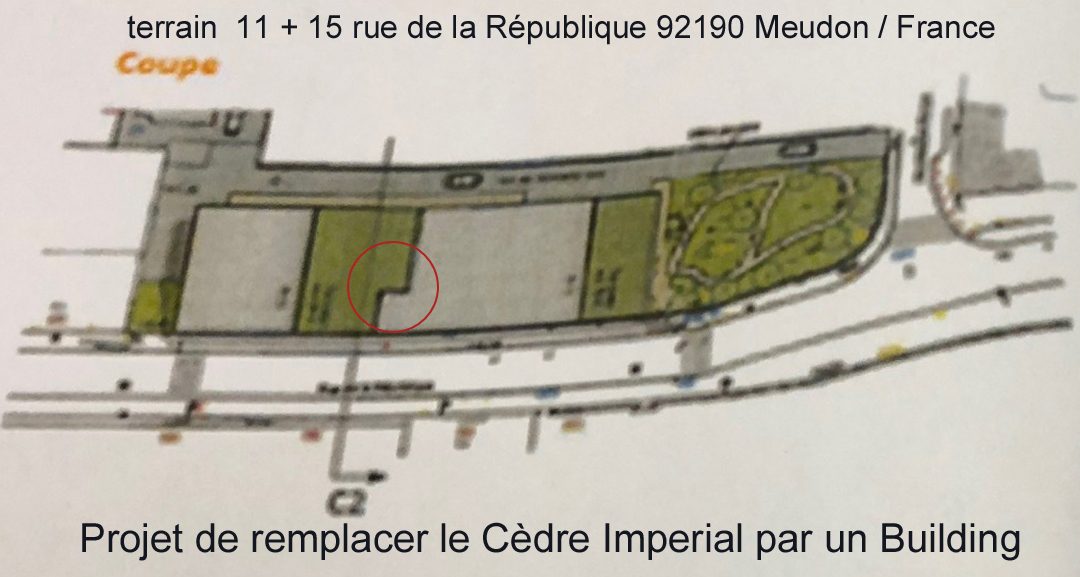
February 2021: the idea of some financial advisers — a municipal building where the cedar stands
The scheme covered the plots at 11 and 15 rue de la République in Meudon: two adjoining parcels brought together for a new building. The cedar stands on the first of them, and the project drawings place it exactly where the storeys of the new block were to rise. The argument put forward was not density but safety: the tree was said to be diseased, therefore dangerous, therefore doomed.
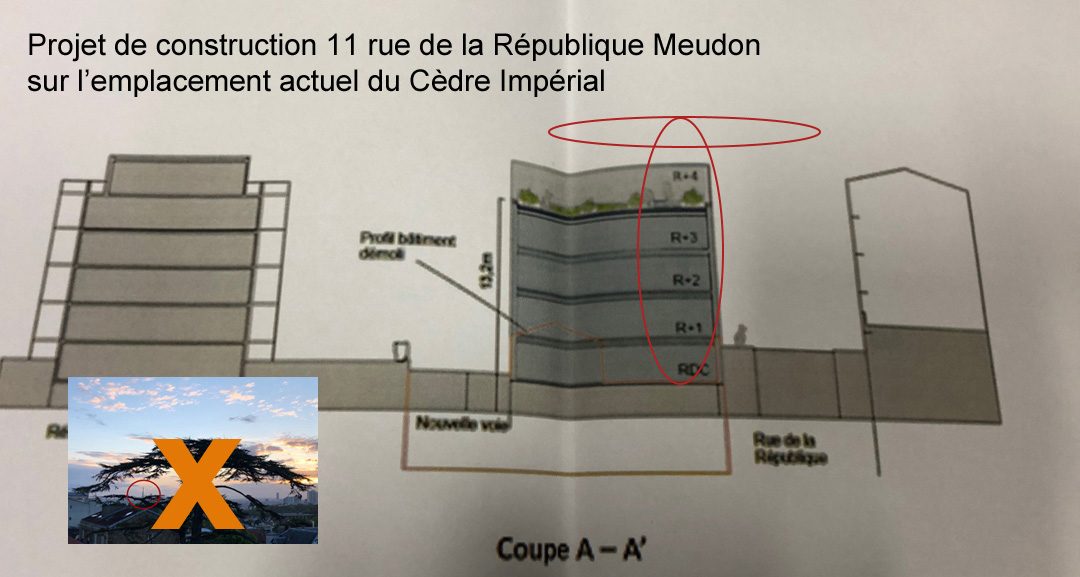
The section says what matters: there was no room for both. A cedar of Lebanon of this size occupies a volume that cannot be moved, and its roots reach far beyond its crown — under what would have become the building site. Keeping the tree meant redrawing the scheme; felling it required only a consent.
Word travelled quickly through the neighbourhood and then well beyond it. What might have been settled in silence became a public matter: neighbours and whole families refused to accept that the oldest witness on the street could come down in a single morning.
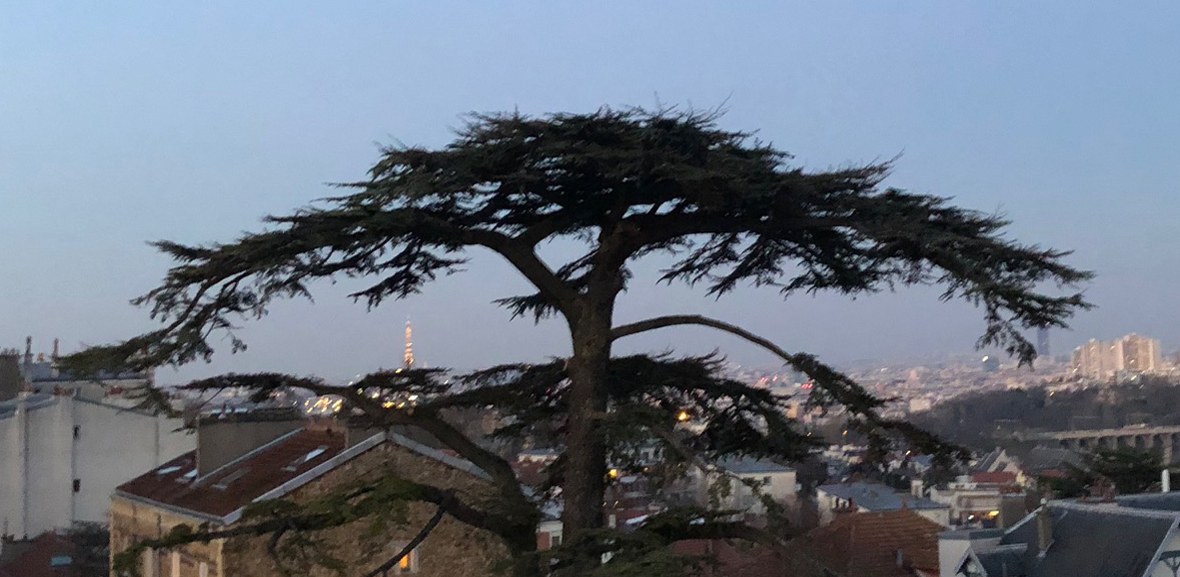
A remarkable tree with almost no protection of its own
One thing here surprises most people. In France a remarkable tree is not protected in its own right: the law does not recognise it the way it recognises a monument. It protects the tree only indirectly, through the land it is rooted in or through a decision that names it expressly.
The first instrument is the town's own planning document, the plan local d'urbanisme. That document can designate ground as an espace boisé classé — classified woodland — which bars any change of use that would compromise the survival of the trees on it. It can also identify one particular tree as an élément de paysage à protéger, a landscape feature to be preserved, under the code de l'urbanisme: works liable to destroy it must then be notified in advance. The second instrument is rarer: classification as a monument naturel under the law of 2 May 1930 on natural monuments and sites, a heavy procedure reserved for cases of manifest public interest.
A local movement, and the unexpected reaction of a mayor
When the idea came up of doing something to save the Cedre Imperial, someone who had tried, without success, to save something beautiful in nearby Ville-d’Avray replied: « je te souhaite bien du courage » — which is French for good luck with the impossible.
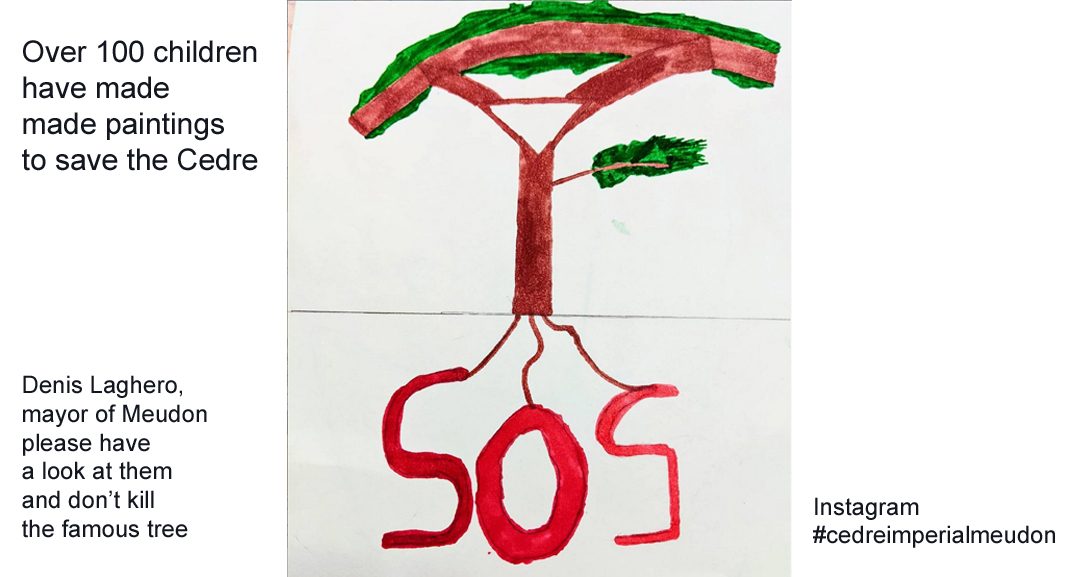
Instead of protest marches and political fights, hundreds of children began drawing the tree. The drawings were posted on Instagram, and some were pinned to the railings of the rue de la République.
At the same time the internet domain cedreimperialmeudon.com was registered and the history of the tree was written down. The most fascinating part came from a former resident of Meudon: a Brazilian Second World War secret service agent who had left this world a decade earlier.
Aimée de Heeren had passed on her love of the cedar to someone two or three generations younger. Not only her love of the tree, but its remarkable wartime story too — that is chapter 4.
Contrary to what many expected, Denis Larghero, mayor of Meudon, listened to the voice of those who loved the Cedre Imperial. He took the decision to keep the tree in place: the building project of his advisers was withdrawn.
A few years later, on 15 March 2026, many friends of the cedar, grateful that the tree had been protected, voted for Denis Larghero — re-elected in the first round with 64.80% of the vote.
Sadly, once the election was over, many came to realise that saving the cedar might only have been a temporary political strategy.
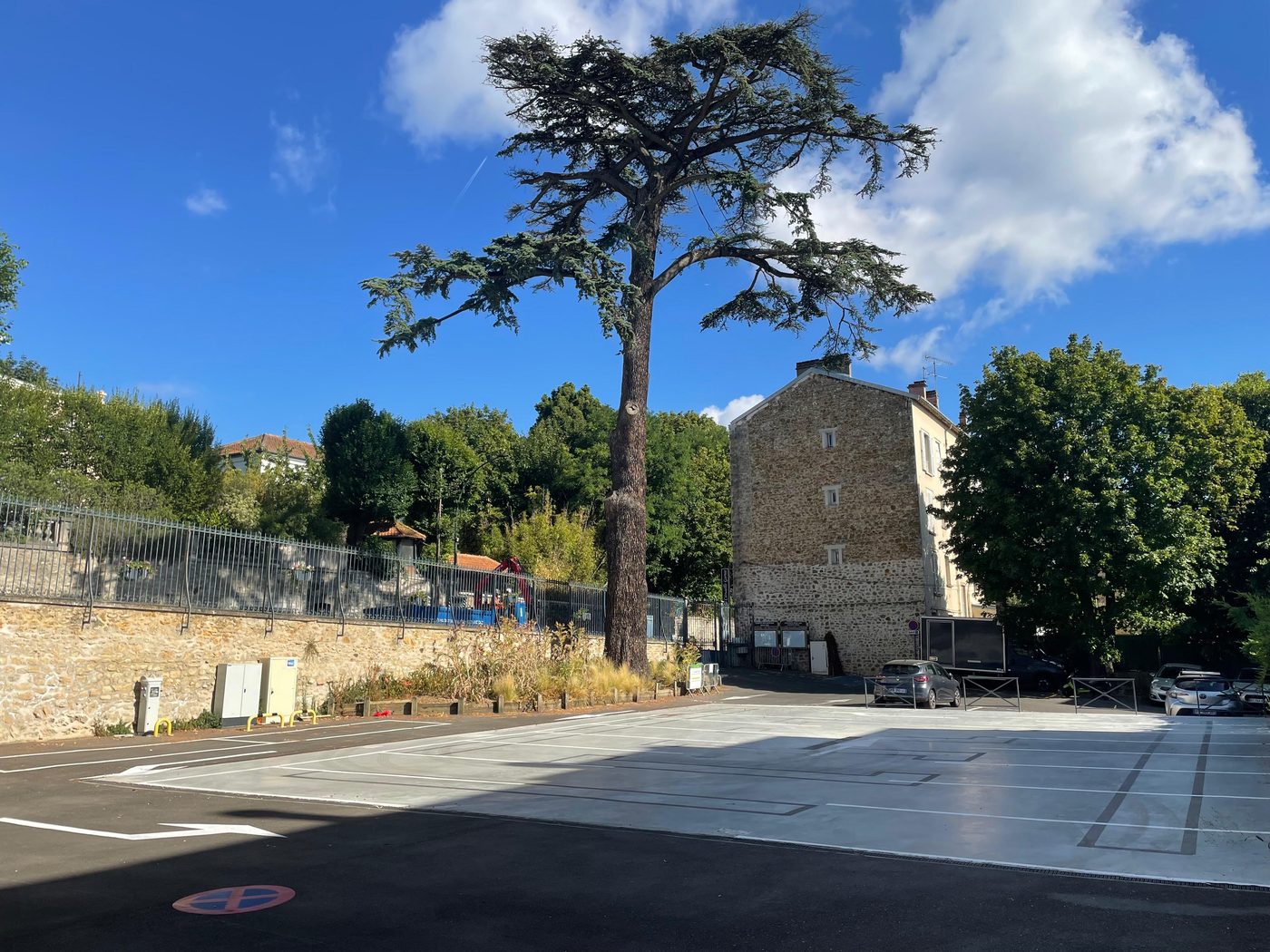
Requests to remove a thick, newly laid concrete slab remained unanswered.
Summer 2026: a new problem appears during heatwaves — the effect of a concrete slab on the roots. That is chapter 8.
February 2021
A building scheme on the plots at 11 and 15 rue de la République threatens the Imperial Cedar.
2021
Neighbours join forces, the ARCBM association is founded, and a petition against the abusive felling of remarkable trees is launched on change.org.
2021
Denis Larghero, mayor of Meudon, listens to the movement: the tree is preserved and is not felled.
2021
No legal status of its own is attached to the tree, which is what the campaign had asked to see put in writing.
March 2026
Denis Larghero is re-elected in the first round, with 64.80% of the vote. Many supporters of the tree voted for him.
Summer 2026
The sealed ground around the trunk becomes the main threat — the subject of chapter 8.
12 August 2026
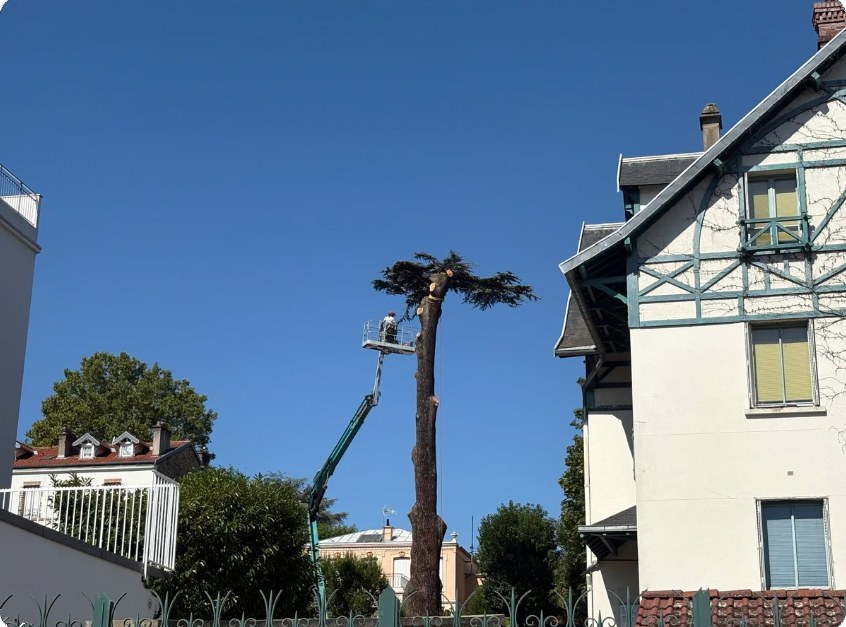
The day of the eclipse. While many are away on holiday and the French courts are closed — leaving no time for any challenge — the historic tree is killed.
Today
The question now is whether the development scheme, massively rejected, is coming back: a socio-medical centre that could stand in any number of other places, without asking to “murder” a beloved tree.
“A two-hundred-year-old tree can disappear in a single morning, because nothing, anywhere, has been written down about it.”
Association pour le Cèdre — ARCBMAfter the development scheme, the concrete
The felling was avoided. What threatens the cedar now is the sealed slab, and the slow thirst it causes.